
Stainless Steel Door Frames and Casings
Retrofit frame systems, corner frames, and wrap-around frames for panels and masonry. Sized for custom wall thicknesses, according to hygiene and thermal engineering criteria.
Looking for a new stainless steel frame for an existing door leaf? Or building a completely new opening in a cleanroom, cold store, production, or packaging area? Our stainless steel frames and casings ensure that the door's surroundings provide the same level of durability and hygiene as the door itself.
The right frame for hygiene
A common problem is that old steel door frames rust, and the paint chips off, while the door leaf might still be usable – or conversely, the door leaf needs replacement, but the wall around the frame has already crumbled. These surfaces pose a hygiene risk and are immediately visible during a serious audit.
Our stainless steel door frames are designed to be ordered independently: they can be installed into an existing wall opening, either after removing the old frame or with partial demolition. The new stainless steel frame covers the defects and provides a uniform, easily cleanable surface.
Advantage: the so-called "wrap-around frame" completely covers the cut edges of the wall and damages to the panel or brick, eliminating the need for separate masonry or drywall repairs after installation.
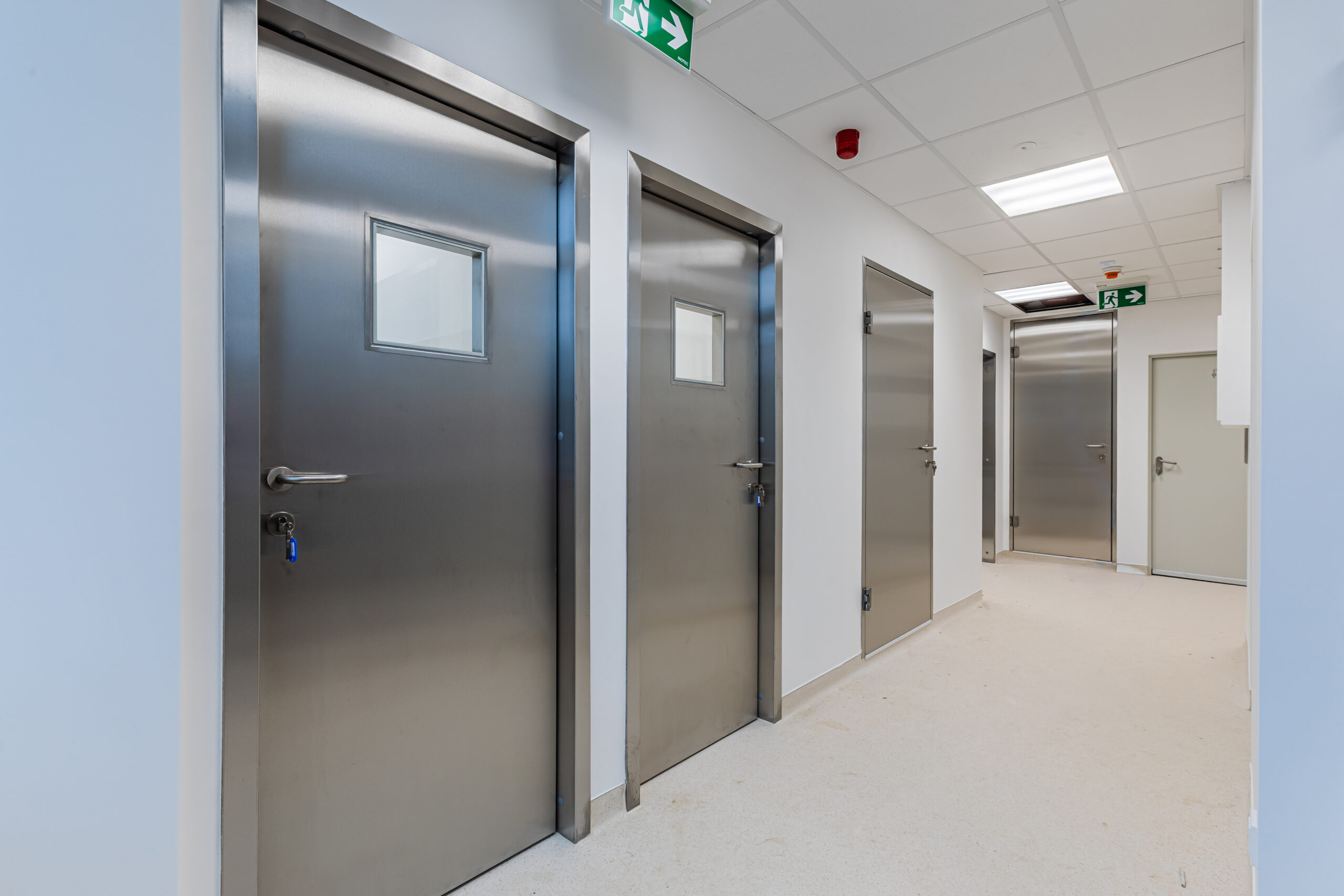
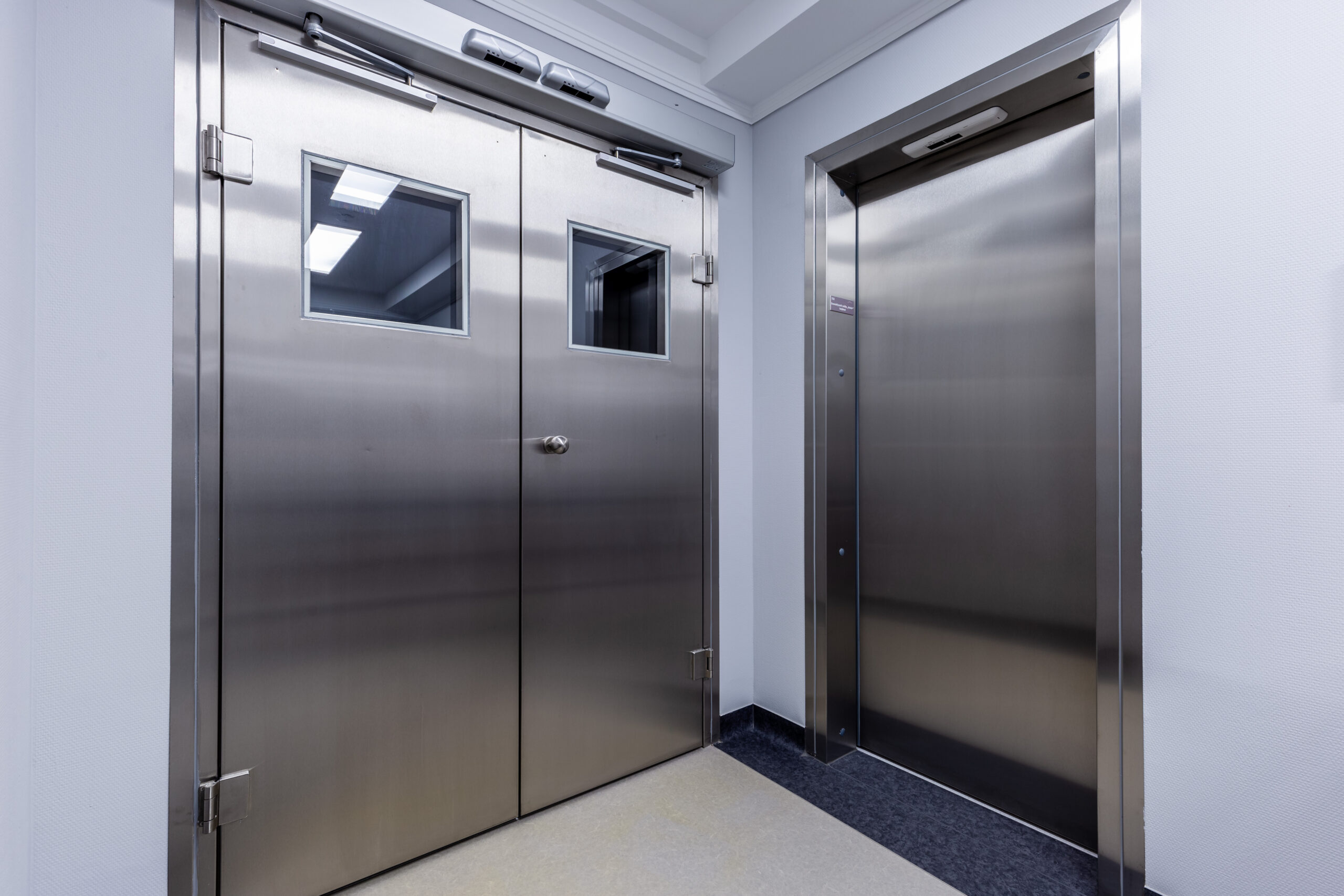
Where is it worth using a stainless steel frame?
In the field of door frames, the stainless steel solution is particularly critical where the door's surroundings are regularly washed, disinfected, or steam-cleaned by staff.
- Cleanroom and GMP corridor doors
- Internal doors of food processing plants
- Openings of cold and freezer rooms
- Washing rooms, cleaning areas, CIP zones
- Logistics ramps and warehouse passages
The stainless steel frame is not only an aesthetic element but also a point of hygienic and mechanical protection: it provides a continuous, cleanable surface from the floor to the lintel, does not crumble, and better resists bumps.
Frame types
We build our solutions around two main frame types: the corner frame that sits on the wall corner, and the wrap-around frame that embraces the wall in its entire thickness. The choice depends on the wall structure, the hygiene level, and whether it is a new construction or a renovation.
Corner frame
One type of corner frame is the "L" cross-section profile, which rests on the outer or inner corner of the opening. An ideal solution if the inner side of the wall opening (reveal) is already covered, but you want to seal the edge of the opening with stainless steel.
The other type is the "C" profile, which is a rigid structure in itself, resembling a hollow section. We fix it with dowels going through the frame or via masonry lugs. The corner frame is the most cost-effective solution if the wall is in good condition but a structure covering the entire wall thickness is not needed.
Wrap-around frame (retrofit installation)
A U-profile that "embraces" the wall, covering its entire thickness. It can be manufactured for any wall thickness – from a 60 mm sandwich panel to a 500 mm brick wall.
The wrap-around frame is especially advantageous during renovations: it covers damaged wall edges and the place of the previous frame, providing a uniform stainless steel surface inside and out, without major masonry work.
Fixing and wall connection
We always adapt the fixing method to the wall structure:
- For panel walls: blind rivet fixing or gluing
- For brick / concrete walls: doweling or gluing
- For lightweight structures: fixing to the structural frame with sheet metal screws, blind rivets, or gluing
- For steel structures: direct fixing with self-drilling screws or to welded receiving elements
- For cold rooms / sandwich panels: thermal bridge-free fixing with special spacers and sealing
The main goal is that the load of the door (the dynamics of opening and closing) does not affect the aesthetic cladding, but the load-bearing wall structure, so the stainless steel frame remains stable and crack-free for decades.
Hygienic sealing: After mechanical fixing, the connection points between the frame and the masonry are sealed with fungicidal, food-grade (HACCP) certified silicone. This guarantees 100% gap-free sealing, preventing moisture or pathogens from getting behind the structure during high-pressure washing.
Frequently asked questions
How is the frame fixed?
For panels, we generally work with blind rivets or gluing, and for brick walls, we achieve a stable hold with doweling and/or gluing. The specific solution is always tailored to the given project.
Can a frame be manufactured for an existing door leaf?
Yes. If the door leaf remains, but you want to replace the frame with stainless steel, based on the available dimensions, we create a frame that can accommodate the existing door leaf and hinge positions.
Is there a thermal bridge-free frame?
Yes. For cold rooms, we manufacture a frame with a full stainless steel structure, with a built-in electric heating wire to prevent the structure from freezing through, stopping condensation and ice formation around the door leaf.
What is the frame made of?
By default, it is made of WNr 1.4301 stainless steel, and upon request, of WNr 1.4404 acid-resistant quality. Surface treatment: natural or brushed, which matches the appearance of the door leaf and surrounding elements.